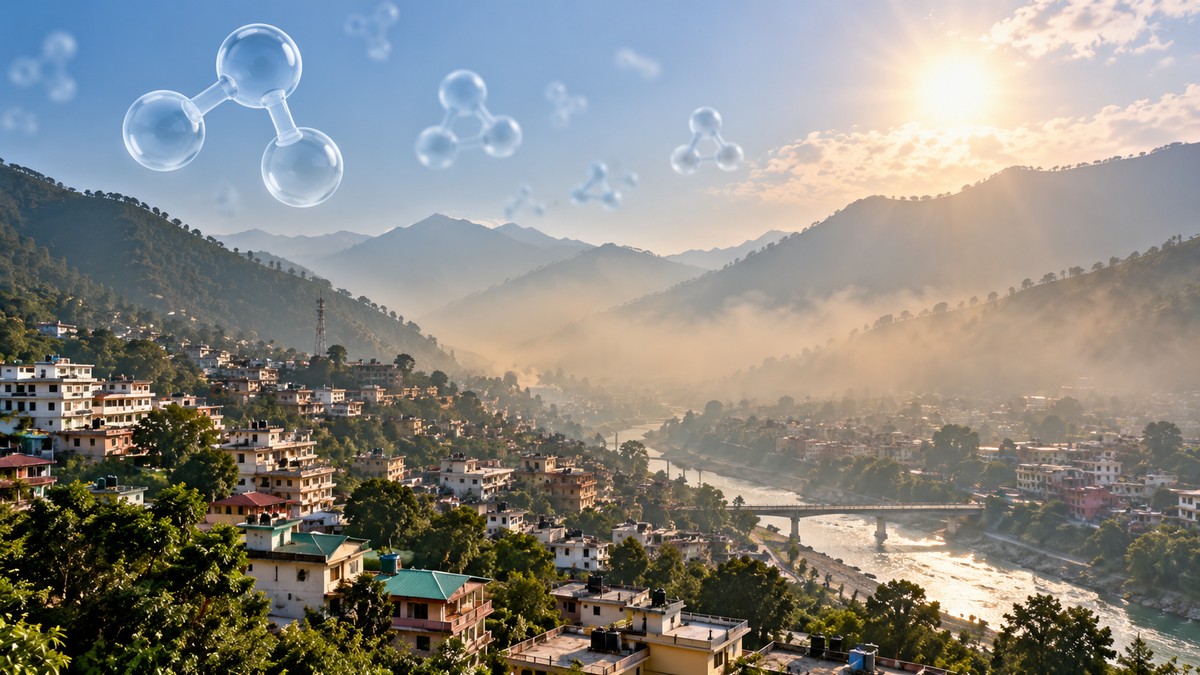
Srinagar Garhwal in Uttarakhand’s Pauri Garhwal district has recorded an unusually high ground-level ozone concentration, with the one-hour reading exceeding 880 micrograms per cubic metre on 19 December 2025. The finding has raised concern because the town is generally associated with cleaner mountain air.
The data was released on Tuesday by the Department of Physics at Hemvati Nandan Bahuguna Garhwal University after continuous air-quality monitoring. The monitoring period ran from 15 September 2025 to 16 September 2026.
The reported one-hour concentration was nearly twice the earlier national high cited in the study. For comparison, the report placed Delhi’s level at 440 micrograms per cubic metre, while the Central Pollution Control Board has recorded 472 micrograms per cubic metre as the country’s previous highest ground-level ozone reading.
The CPCB figure was measured as an 8-hour average at the CRRI-Mathura Road station in Delhi on 19 May 2025. Because the Srinagar reading is a one-hour measurement, the 2 figures use different averaging periods and should not be treated as identical measures.
Forest fires and combustion sources under study
Scientists have identified forest fires as the leading initial explanation for the sharp rise. Dr Alok Gautam, a professor in the university’s Department of Physics and a monitoring scientist, said the sudden increase required serious investigation.
Dr Trilok Chand Upadhyay, who was part of the study, said forest fires release large quantities of gases and particles into the atmosphere. Nitrogen oxides from vehicles and other combustion sources also contribute to ozone formation.
These observations describe the scientists’ initial assessment. The supplied findings do not establish a single confirmed cause for the December spike.
Pollution can remain trapped in the valley
Srinagar also recorded an 8-hour rolling ozone average of 634.13 micrograms per cubic metre. That was more than 6 times the CPCB’s national 8-hour limit of 100 micrograms per cubic metre for ozone.
Researchers analysed 339 days of observations. Ozone exceeded the national standard on 26 of those days, representing about 7.7% of the monitored period.
The town’s geography and weather patterns may help explain why pollution levels rise. During winter, a colder air layer can remain near the ground while warmer air sits above it. Such conditions restrict dispersion and allow pollution to accumulate within the valley.
Why the finding matters locally
Srinagar is a small town in the hills and an important stop on routes serving the Badrinath and Kedarnath pilgrcircuits. The monitoring results therefore matter beyond the town’s permanent population, particularly because the area is widely viewed as a clean-air mountain destination.
The available findings point to the need for closer examination of ozone behaviour in the valley, including the influence of fires, vehicles, combustion sources and winter atmospheric conditions. The material does not provide a separate health-impact assessment or announce a regulatory response.
Conclusion
Srinagar’s monitoring data shows a major ground-level ozone spike, alongside repeated breaches of the national 8-hour standard. Scientists have identified several possible contributors, but the precise cause requires further study.
Frequently Asked Questions
Q. Where was the high ozone reading recorded?
Srinagar Garhwal in Uttarakhand’s Pauri Garhwal district recorded the reading.
Q. When did the one-hour ozone level exceed 880 micrograms per cubic metre?
The reading was recorded on 19 December 2025.
Q. What was Srinagar’s 8-hour rolling average?
The 8-hour rolling average was 634.13 micrograms per cubic metre.
Q. What is the CPCB’s national 8-hour ozone limit?
The national 8-hour limit cited in the findings is 100 micrograms per cubic metre.
Q. On how many monitored days did ozone exceed the standard?
Ozone exceeded the national standard on 26 of the 339 monitored days, or about 7.7% of the period.
Q. What factors have scientists identified as possible contributors?
The initial assessment points to forest fires, vehicle emissions, other combustion sources, and weather conditions that can trap pollution in the valley.
Q. Which university monitored the air quality?
The Department of Physics at Hemvati Nandan Bahuguna Garhwal University conducted the monitoring.