
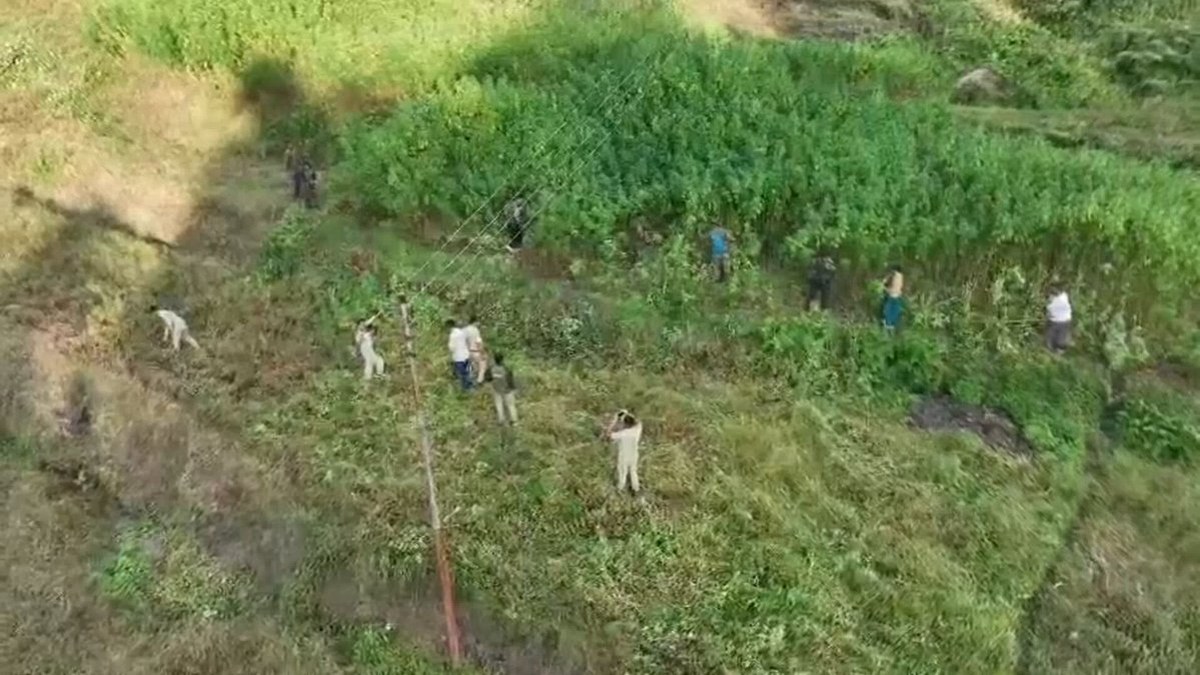
A multi-department team has destroyed illegal cannabis grown across around 70 naali at Rampur Tok in Dewal, Chamoli, as part of Uttarakhand’s “Drugs Free Devbhoomi” campaign.
The operation was carried out by Chamoli Police with personnel from the Special Operations Group, the Dewal police out, the Social Welfare Department, the Legal Services Authority and the Forest Department. The action focused on removing the crop and informing residents about the legal risks linked to unauthorised cannabis cultivation.
Officials also spoke about the health and social damage associated with drug abuse. Villagers were asked to remove wild cannabis plants found in nearby areas, extending the campaign beyond the cultivated patch.
Police add cyber fraud warning
During the village outreach, SOG in-charge SI Satendra Butola cautioned residents about several forms of online fraud. The warnings covered fake KYC requests, online investment schemes, digital arrest scams and suspicious links.
Residents were advised to report cyber fraud through 1930. The message placed drug prevention and digital safety together in the team’s interaction with the village community.
Why industrial hemp is part of the debate
The destruction has also brought attention to a separate question about livelihoods in the hill districts. Farmers have long faced crop losses caused by monkeys and wild boars, with damaged fields and abandoned terraces making cultivation difficult for many families.
Industrial hemp is different from drug-producing cannabis. The low-THC variety is used for products including fibre, textiles, rope, seed oil, building materials and medicines. Its cultivation requires a legal framework and cannot be treated as permission to grow unauthorised cannabis.
Uttarakhand was the first state in India to legalise industrial hemp cultivation. However, the sector has not developed into a large-scale livelihood opportunity because markets and workable operating rules have remained limited.
Himachal Pradesh offers a contrasting model
Himachal Pradesh is pursuing state-licensed industrial hemp cultivation with a THC ceiling of 0.3%. The model aims to replace wild cannabis with a regulated crop that can be linked to legal production and commercial buyers.
The sector is expected to generate $120 to $240 million annually after reaching scale. That projection has added weight to the argument that hemp could become an income source in areas where conventional farming is under pressure from wildlife damage.
For Uttarakhand, the central challenge is balancing enforcement against illegal cannabis with a clear route for lawful industrial hemp. Such a route would require licences, approved seeds, buyers and support for growers, rather than simply allowing cultivation without oversight.
The Chamoli operation itself was an enforcement and awareness exercise. It did not announce a new industrial hemp programme. The wider discussion concerns whether the state can build a controlled market while continuing to prevent drug-linked cultivation.
Conclusion
Chamoli’s 70-naali operation underlines the campaign against illegal cannabis, while the wider hemp debate focuses on whether tightly regulated cultivation could support hill livelihoods without weakening drug-control efforts.
Frequently Asked Questions
Q. Where was the illegal cannabis destroyed?
The cannabis was removed from around 70 naali of land at Rampur Tok in Dewal, Chamoli.
Q. Which campaign covered the operation?
The action was conducted under the “Drugs Free Devbhoomi” campaign.
Q. Which departments joined Chamoli Police?
The team included the SOG, Dewal police out, Social Welfare Department, Legal Services Authority and Forest Department.
Q. What cyber threats were discussed with villagers?
The warnings covered fake KYC, online investment scams, digital arrest fraud and suspicious links.
Q. Which number should be used to report cyber fraud?
Residents were urged to report cyber fraud on 1930.
Q. What is industrial hemp used for?
Industrial hemp can be used for fibre, textiles, rope, seed oil, building material and medicines.
Q. What THC limit is linked to Himachal Pradesh’s proposed model?
The state-licensed model uses a 0.3% THC limit.
Q. Which Indian state first legalised industrial hemp cultivation?
Uttarakhand was the first state in India to legalise industrial hemp cultivation.