Khatima Story: The name Uttarakhand often brings to mind snow-covered peaks, winding mountain roads, deep valleys and forests of pine and deodar. But there is another side of Uttarakhand—one where vast agricultural fields stretch across the horizon, dense forests surround settlements, rivers and canals shape everyday life, and the international border with Nepal lies just a short distance away.
This is Khatima.
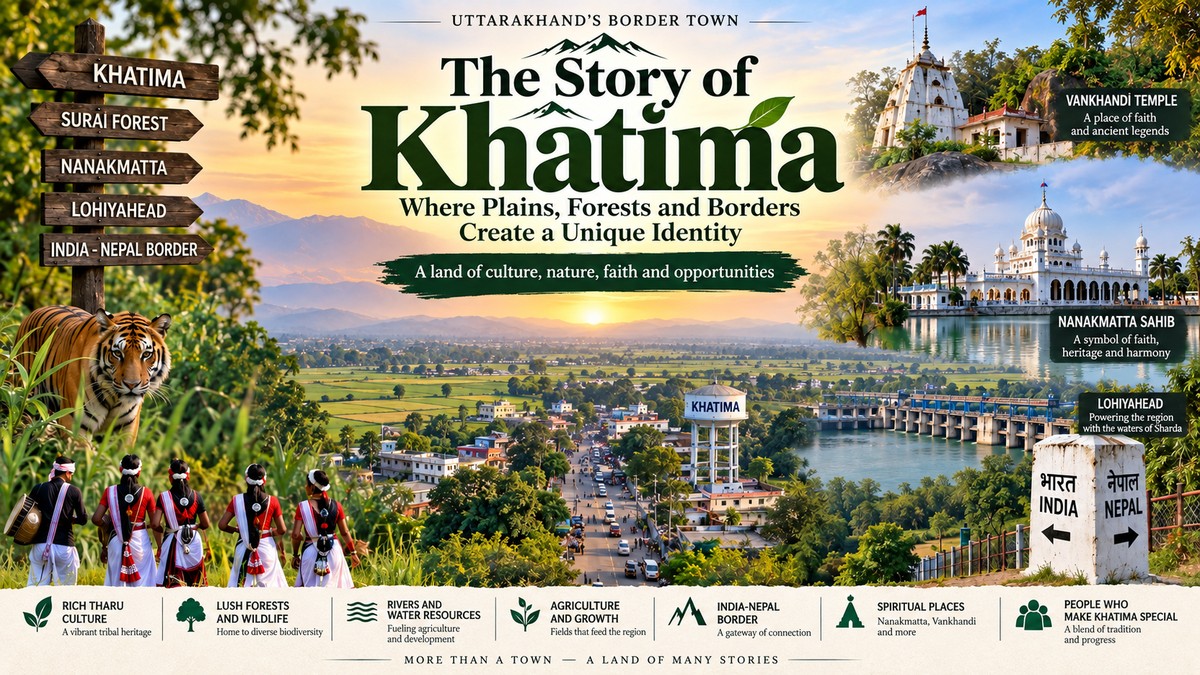
Located in Udham Singh Nagar district, Khatima is much more than a border town. Its identity has been shaped by the culture of the Terai, the heritage of the Tharu community, surrounding forests, agriculture, water resources and its proximity to the India-Nepal border.
Together, these elements give Khatima a character quite different from many other towns of Uttarakhand.
A Different Side of Uttarakhand
Uttarakhand is remarkably diverse in its geography, and Khatima is a perfect example of that diversity.
Unlike the steep slopes and narrow valleys associated with the hill towns of the state, Khatima is situated in the plains of the Terai region of Kumaon.
Here, the landscape opens into agricultural fields, forests, villages, canals and expanding urban settlements.
Move beyond the busy town centre and the scenery begins to change quickly. Farmland appears on one side, forest stretches on another, while canals and other water systems are visible across the region.
This combination gives Khatima its distinctive geographical identity.
The Rich Heritage of the Tharu Community
The story of Khatima cannot be told without mentioning the Tharu community.
The Tharu tribe has a significant presence in the Terai belt of Uttarakhand, and Khatima and its surrounding villages are among the important areas associated with Tharu culture.
Over the years, the town has expanded, markets have grown and modern lifestyles have reached villages. Yet the traditional culture of the Tharu community remains an important part of the region's identity.
Traditional customs, clothing, food, festivals, folk traditions and dances represent a cultural heritage that has been passed from one generation to another.
It is one of the most fascinating chapters in Khatima's story.
Where the Town Meets the Forest
Another remarkable feature of Khatima is its proximity to forests.
The Surai forest area near Khatima is known for its biodiversity. Dense forests and wildlife make this landscape environmentally important.
For people living in and around Khatima, forests are not merely distant tourist destinations. They are part of the geography and everyday identity of the region.
This is why Khatima cannot be described simply as an expanding town. It is also a Terai settlement closely connected with forests and wildlife.
Nepal Is Just a Short Distance Away
One of the most interesting aspects of Khatima is its geographical location.
The town lies very close to the India-Nepal international border, making it an important border region of Uttarakhand.
The proximity of Nepal has influenced the social and economic life of the area for decades.
India and Nepal share deep historical, cultural and social ties, and these connections are especially visible in border regions. Movement and interaction between communities on both sides have contributed to the unique character of the area.
To understand Khatima, therefore, it is not enough to see it simply as another town in Uttarakhand.
It is also a borderland where two countries come geographically close and where connections between people often go much deeper than the boundary on a map.
Sharda's Waters and the Importance of Lohiyahead
Water has also played an important role in shaping Khatima and the surrounding region.
The Sharda River and associated water systems are important to this part of the Terai. Nearby Lohiyahead is also associated with hydroelectric power generation.
Canals and water resources have influenced agriculture and the economy of the wider region.
For Khatima, therefore, water is not simply a natural resource. It is also part of the area's development story.
Agriculture Has Shaped Khatima Too
Khatima's urban landscape continues to expand, but its roots remain deeply connected with the agricultural Terai.
Travel beyond the town and large stretches of farmland make this immediately visible.
Crops such as paddy, wheat and sugarcane have long been associated with agriculture in the region.
Fertile Terai soil and the availability of water helped provide a strong foundation for farming. Over time, trade, industry, transportation and other businesses expanded, but agriculture continues to play an important role in the economy of surrounding rural areas.
The Historic Connection with Nanakmatta
The wider Khatima region is also significant from a religious and historical perspective.
Located nearby, Nanakmatta Sahib is an important Sikh pilgrimage centre. According to tradition, Guru Nanak Dev Ji visited the area during his travels.
Today, Nanakmatta and the nearby Nanak Sagar are important parts of the religious and historical identity of this region.
This means that within a relatively short distance around Khatima, a visitor can experience Terai culture, forests, border life, agriculture and an important spiritual heritage.
Perhaps This Is Khatima's Real Beauty
At first glance, Khatima may appear to be an ordinary town in the plains of Uttarakhand.
Its busy markets, traffic, expanding neighbourhoods and growing population may resemble many other small Indian towns.
But travel a little beyond the crowded streets and another Khatima begins to appear.
There are fields on one side and forests on another. The Sharda and its water systems have shaped the landscape. The heritage of the Tharu community survives across the region. Nepal lies just beyond the border, while historic and religious destinations such as Nanakmatta add another layer to its identity.
Perhaps the real beauty of Khatima is not hidden in one famous tourist attraction.
It lies in the countless stories scattered across its forests, villages, fields, waters, borderlands and the lives of the people who call this region home.
And once we begin discovering those stories, Khatima stops looking like just another town on the map of Uttarakhand.
It becomes a region filled with layers of history, culture, nature and human connections—each waiting to tell its own story.